Featured Posts

Flu Shot Symptoms and who should get a flu shot

It's time for your flu shot this year, and you want to know who should get a flu shot. It's important to avoid the flu and stay h...

Showing posts with label children's health. Show all posts

7/15/17

Making healthy food choices occasionally can increase your life span, says study!


The report in the New England Journal of Medicine is the first to show that improving diet quality over at least a dozen years is associated with lower total and cardiovascular mortality.

New Delhi: Nobody's perfect and neither are our eating habits – even those on a diet have their cheat days once in a while.

That said, many people would agree that health food is devoid of taste and not exactly what someone would prefer to eat, especially when they can't eat their favourite foods.

But even if you eat healthy food and consciously make good food choices once in a while, it will help improve your longevity, a study has found.

As per the US study, choosing healthier foods now and then may significantly boost one's chances of living longer.

The report in the New England Journal of Medicine is the first to show that improving diet quality over at least a dozen years is associated with lower total and cardiovascular mortality.

Researchers at Harvard University tracked dietary changes in a population of nearly 74,000 health professionals who logged their eating habits every four years.

Researchers used a system of diet-quality scores to assess how much diets had improved.

For instance, a 20-percentile increase in scores could "be achieved by swapping out just one serving of red or processed meat for one daily serving of nuts or legumes," said a summary of the research.

Over the 12-year span, those who ate a little better than they did at the start – primarily by consuming more whole grains, fruits, vegetables, and fatty fish – saw an eight to 17 percent lower risk of dying prematurely in the next 12 years.

Those whose diets got worse over time saw a higher risk of dying in the next 12 years of follow-up, on the order of a six to 12 percent increase.

"Our results highlight the long-term health benefits of improving diet quality with an emphasis on overall dietary patterns rather than on individual foods or nutrients," said senior author Frank Hu, professor and chair of the Harvard Chan School Department of Nutrition.

"A healthy eating pattern can be adopted according to individuals' food and cultural preferences and health conditions," he added.

"There is no one-size-fits-all diet."

Who's stopping you: Healthy food is boring? These recipes will change your mind

My kind of balanced eating: a flavour-filled feast with good-for-you ingredients

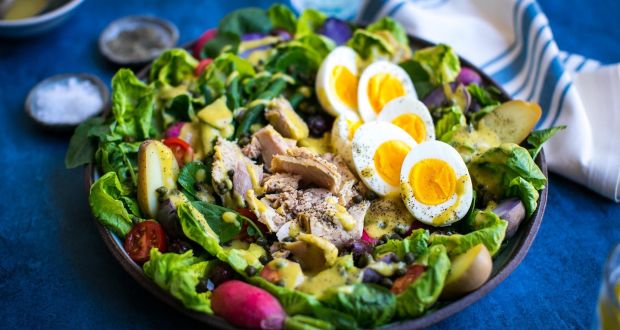
Niçoise tuna with tender boiled eggs

Sport and fitness were not high on my agenda when I was growing up. I was famous in my school for scoring the only own-goal in the school’s sporting history. I knew, as I sat in the school bus on the way home, filled with shame, that sport would not be my forte.
Thankfully, my interest in food kept me occupied during my formative years, but now that I am slightly older and working in a job that requires plenty of eating, finding an activity that keeps me active and I actually enjoy has been important.
Recently, when I moved to Los Angeles, with a lack of cliffs and green landscapes to hike with the dog, I was all set to finally find an activity I could call my own. A crossfit gym in the neighbourhood was offering free trial classes, so I signed up. A week of not being able to walk after dropping a kettle bell on my foot, combined with muscles that were in protest after what they had been subjected to, meant that crossfit was certainly not for me.
After a couple more false starts, with a soul cycle class – pedalling to music while going nowhere fast on a stationary bike – that nearly caused me to collapse, and a cardio barre class that had me exercising with a ballet bar, I stumbled across hot yoga. 
I had been to regular yoga classes before and had fallen in and out of them over the years, but this time I became completely obsessed. I go almost every day. For the first time, I’m excited about exercise, and with all this extra energy being expended, having a balanced diet has never been more important to me.
The recipes this week are aimed at more-balanced eating. Fresh vegetables, good grains and protein are all high on the menu.
A niçoise salad with the spoils of summer, a spiced fish dish full of vibrant colour and flavours and – for those looking for a sweet treat minus the processed sugar – mango, chia seed and yoghurt ice pops to keep you cool.
This is my kind of balanced eating: a feast of flavour filled with ingredients that are good for you.

NIÇOISE TUNA WITH TENDER BOILED EGGS

A niçoise salad might feel somewhat passé, but it’s time for a comeback. This is instant summer food: fresh summer vegetables arranged on a platter with the best-quality tuna – or fish of your choice – pepped up with salty capers, olives and peppery French mustard dressing. Add or subtract ingredients as you wish: this is an ideal salad for interpretation.
Serves 4
200g small, waxy purple and red potatoes
3 large free-range eggs
250g green beans, topped and tailed
2 baby gem lettuce heads, washed and leaves separated
A good handful of watercress, washed
300g of line-caught tuna in olive oil
200g olives, pitted
8 radishes, halved
100g cherry tomatoes, halved
3tbs capers
For the French mustard dressing:
3tbs extra virgin olive oil

Continue Reading >> Source: https://www.irishtimes.com/life-and-style/food-and-drink/healthy-food-is-boring-these-recipes-will-change-your-mind-1.3145707

Who's stopping you: Finally, healthy eating trend catches up

Little to nothing in Obamacare or the Republican replacement effort gets at the issue of reducing health care costs by stopping its true cause, the substantial increase in chronic disease. Type 2 diabetes has grown from 2.2 million to 29 million in America since 1974 when I started to practice.

Hip and knee replacements largely for arthritis from 64,000 to over 1 million; dementia costs from under $10 billion in 1974 to $216 billion in direct federal costs in 2014. You get the picture. Chronic disease is increasing seven-fold faster than our population.

Our genes haven’t changed. Our habits and culture have. We need a World War II effort to save America. Everyone knew in WWII all had to pitch in to survive. That is how serious the influx of chronic disease is. And like in WWII, we think a culture change and a new set of rules promoted by the government are needed.

In 2005, when I arrived in Cleveland and looked at the data, it was obvious that we needed to offer healthier food to America. Without it, America’s medical costs would increase and put the country in jeopardy. It became obvious to me that we needed mass produced food that was healthy.

So I went to the head of one of the three biggest food processors in America and suggested America needed his company to start making food that loves your body as their mainstream foods. These food processors and this one in particular stock the shelves of the biggest grocery stores and provide the ready to use foods for fast and quick serve establishments and restaurants. His response: “Mike, I can’t do it, it’s just a fad. America doesn’t want healthy options. I have to provide what America wants.”

I pleaded and showed him the data. It was obvious by 2005 that America’s weight was going up more than 1 pound per year per person and health going down, enough to bankrupt the country from the cost of care for diabetes, cancer, heart disease, dementia, arthritis and kidney disease that obesity promotes. We were living through the delayed costs from tobacco and despite big tobacco’s best promotional efforts, tobacco-use rates were clearly on the way down from 45 percent of the population in about 1960 to under 25 percent in 2005, and still declining. It is now at about 15 percent.

But if the food choice change took the more than 50 years now required to change tobacco use, our country would be bankrupt. I wondered if we could legislate that healthy food had to be available. And research looking at the safety and effectiveness of government food regulations has shown that responsible rules and regulations can pay off big dividends, not only when it comes to saving lives and preventing the suffering of millions of you, but also by saving big bucks and making our health care system run more smoothly and efficiently.

Let’s start with a look at how food policies could and do affect those suffering from heart disease. In a recent study from the University of Liverpool School of Public Health, researchers estimated that in the United States a 10-percent tax on sugar-sweetened beverages could prevent 31,000 deaths from cardiovascular disease every year. But there’s no reason to stop with policies that impact sugary drinks.

A 30-percent fruit and vegetable subsidy targeting only food stamp recipients was estimated to avert 35,100 cardiovascular deaths and erase economic disparities in health outcomes; a mass media campaign to change dietary habits might avert 25,800 cardiovascular deaths. Instituting all the above could change the health of the nation and the wealth of the country. Plus, the scheduled 2018 ban on trans fats that clog arteries, boost inflammation and promote heart disease could immediately produce more than $60 billion in annual health care savings.

Every three years, I’ve gone back to the CEO of that food company and asked him to “go healthy.”

In the meantime, his sales have only grown. His answers always have been the same: “Mike it’s just a fad. America doesn’t want healthy options.”

But when I visited this year, I saw many healthy foods in the test kitchen, and beginning to roll off the production line. I asked him what was up. His response: “Mike, we’re going with it. Healthy food is now a trend. America wants it.”

Source: http://www.clevelandjewishnews.com/features/health/finally-healthy-eating-trend-catches-up/article_1b17dcd6-67e2-11e7-941d-afea31373ba5.html

7/14/17

Who's stopping you: Children's health comes first when fixing school lunches

In May, the Trump administration rolled back reforms implemented by President Barack Obama to the National School Lunch Program, which feeds over 1.3 million kids throughout New York state. This move undermines the health of New York's youth, particularly those from impoverished families that depend on schools to provide nutritious meals to their children.

Specifically, the Trump administration eased requirements for using whole grains, as well as maximum sodium content in school lunches. Flavored milk options, which contain sugar and other additives, are now allowed again. The administration also eased requirements for reporting school meal nutrition information to parents. While these changes may seem modest, I need to explain them within the context of what I see in my pediatrics practice every day at The Nest, a community health center run by Harlem United in New York City.

There is a pediatric obesity epidemic in New York state. Obesity among children and adolescents has tripled over the past three decades, and currently, one-third of New York's children are obese or overweight. As a result, unprecedented numbers are afflicted with health conditions that traditionally only affected adults, including hypertension, diabetes, elevated blood pressure, and high cholesterol. These related ailments not only pose major challenges to children's health, but also can shorten their lifespan. It is no wonder that childhood obesity is now the No. 1 health concern among parents, beyond smoking and drug use.

While it is true that poor dietary choices and a sedentary lifestyle can increase the likelihood of childhood obesity, there is more added sugar and salt in the American diet than there has ever been. The current recommended daily allowance of sugar for children ages two to 18 is less than six grams. Yet, on average American children consume more than three times that amount.

Sugar-sweetened beverages like soda, juice, energy drinks and flavored milks contribute to the greatest share of these empty, dangerous calories. Additionally, 90 percent of children eat more than the recommended daily allowance of salt, which contributes to nearly one-sixth of children nationwide having elevated blood pressure.

Sonny Perdue, the newly-minted U.S. Secretary of Agriculture, argues that relaxed and local control of food standards will improve palatability and the likelihood that students will eat their lunch instead of throwing it away. But as a pediatrician, I know that food can both be healthy and taste good, too.

Children must be taught and encouraged to eat healthfully. It is certainly true that healthy behaviors start at home, but school meals have a big role to play in mitigating New York's childhood obesity epidemic and in countering the slick and savvy packaged food industry marketing directly targeted at children.

Laws and regulations that ensure our children eat nutritious, tasty school lunches need to be strengthened, not rolled back for the benefit of the packaged food industry at the cost of our children's health.