Featured Posts

Flu Shot Symptoms and who should get a flu shot

It's time for your flu shot this year, and you want to know who should get a flu shot. It's important to avoid the flu and stay h...

Showing posts with label how to. Show all posts

7/26/17

12 ways to eat well in the summer. Who's Stopping You?


Before you reach for the Haagen Dazs, check your fridge for the following: soft fruits (like berries, nectarines or plums) and Greek yogurt. "By blending the two together with a dash of honey, you've made a healthy ice lolly mix - just pop into moulds and freeze," says Laura. If you fancy something sweeter and more of a 'treat', try Laura's banana lolly idea. "Slice a banana in half and pop it on a lolly stick, before dipping it in melted chocolate and nuts. Then freeze on a baking tray." The benefits? "They're much lower in sugar than regular lollies and full of vitamins and healthy fats (if you add nuts). And because frozen foods take longer to eat, you'll feel more satisfied, too."


The sun is finally shining and those BBQ invites keep rolling in. But if you're wary of falling off the healthy-eating bandwagon, help is at hand. From smart snacking to DIY drinks and healthy salad dressings, dietician Laura Tilt has helped us devise some foolproof tips to stay happy - and healthy – all summer long (and they're all tasty, too).

1. Go crazy for fruit and veg

During summer it's more important than ever to stay hydrated and the good news is, fruit and vegetables count towards our daily fluid intake. "Eating more fresh fruit and veg during summer is an easy way to increase our water intake thanks to their high water percentage," explains Laura. "As well as being hydrating, orange or red fruits also contain beta-carotenes which help to protect our skin from the sun – so get plenty of those. When it comes to veg, opt for brightly or darkly-coloured leaves - like watercress or rocket - which are full of antioxidants. It's also worth checking what's in season (Love British Food have a handy list). Not only is it better for the environment, but some studies have found more nutrients in produce bought seasonally."

2. Make your own ice lollies

7/21/17

Yes, Dads Give Kids Less-Healthy Food: Here's Why


Hey, Dads!

It's a childhood memory that many people may have: When Mom isn't home for dinner, Dad takes charge … and orders pizza. Or throws some hot dogs in the microwave. Either way, it's not a choice Mom approves of.

Now, a small new study shows that dads really do make less-healthy choices when feeding the family — and this can take a toll on moms.

Study author Priya Fielding-Singh, a doctoral candidate in sociology at Stanford University in California, said she was not surprised that the fathers in the study did less housework, including both "food work" and childcare, than mothers — indeed, national data has previously shown this unequal division of labor is common. But what was surprising in the new study was that dads' lack of involvement in feeding the family can really take a toll on moms, Fielding-Singh said. [10 Ways to Promote Kids' Healthy Eating Habits]

"Many dads are less invested in some of the healthy-eating priorities that moms really hold dear," and that can lead to more work, and more stress, for moms, Fielding-Singh told Live Science. And teens take note of these family dynamics, she added.

In the study, published online in June in the journal Appetite, Fielding-Singh interviewed 42 moms, 14 dads and 53 teens from more than 40 families in the San Francisco Bay Area and asked about family responsibilities when it came to family meals. All of the families were middle class or upper-middle class.

Fielding-Singh found that in 41 of the 44 families included in the study, the family members agreed that Dad's eating habits were less healthy than Mom's. It wasn't just that the moms considered themselves healthier than their husbands, Fielding-Singh noted: The dads agreed.

Set dynamics?

Though some of the moms in the study said they were happy to do most of the work required to feed the family, other moms said they wanted the dads to do more, such as grocery shopping and cooking, Fielding-Singh said.

But there was a catch: Moms felt that if they let dads do these tasks, the food would end up being less healthy, Fielding-Singh said. So, by letting dads more to do, moms felt like they were being worse caregivers to their children. This, in turn, made moms feel guilty — so they kept doing most of the tasks themselves, instead of delegating them to dads.

"Even though some moms were unhappy with it, few saw that there could be an alternative," Fielding-Singh said. "There was definitely a resignation" on the part of moms, she added.

Some of that resignation may stem from deeply embedded gender roles.

"Feeding families is very central to motherhood," she said. "We hold mothers accountable for the foods that families eat." Mothers often judge themselves, and other moms, by how well they feed their families, she noted.

Dads, on the other hand, aren't usually seen as being responsible for feeding the family, Fielding-Singh said. Instead, fathers have typically been judged by how well they support their families financially and more recently, how involved they are in children's lives. But getting kids to eat healthy? That didn't factor in as an important part of being a father, she said. [History's 12 Most Doting Dads]

"It's not that the husbands were trying to be unfair to their wives" by not taking on the responsibilities of food work, she said. Dads weren't trying to hurt their kids diets or make the moms' lives harder, for example. "They simply didn't see it as their responsibility to be making sure that kids were eating healthy — they saw it as Mom's responsibility." And moms, she added, also saw it as Mom's responsibility.

But it's possible that this division of labor between husbands and wives wasn't always present in the couples' relationship. As a part of her interviews, Fielding-Singh said that she asked parents what changed about the way they approached food once they had kids. "What was striking," she said, was that "almost every mother" said things changed after she had kids, but the responses were more mixed among dads. In other words, many women seemed to become more concerned about the healthiness of food, rather than the men getting less concerned.

That means that it's possible things were more equal before kids came into the picture, Fielding-Singh said. But "because feeding is so gendered, it's almost as if this dynamic was created whereby mothers instantly cared more" once they had children.

Teens take note

The division of labor between Mom and Dad didn't just affect their own relationships; these differences in approaches to feeding the family also stood out to parents' teenage children, the study found. [10 Facts Every Parent Should Know About Their Teen's Brain]

The teens interviewed "very clearly understood and articulated that their parents had different priorities around healthy eating," Fielding-Singh said.

This divided approach is notable because kids could view their parents as a united front or solid unit, Fielding-Singh said. For example, teens might say, "my parents"care about my education — but this is not the case with food. Instead, teens might say, "my mom" cares about eating healthy, but "my dad" doesn't.

One of the reasons this matters, Fielding-Singh noted, is that teens observe their parents, and they learn how to behave, in part, from what they see their parents do. And in the study, many daughters watched their moms do the food work and the health work, and many sons watched their dads, and saw that their dads left the work to their moms, she said.

The fact that teens picked up on this "so clearly" means that "there's a real possibility that this one of the ways gender norms are transmitted," Fielding-Singh said.

Source: https://www.livescience.com/59868-moms-dads-feeding-families.html

7/15/17

Who's stopping you: Healthy food is boring? These recipes will change your mind

My kind of balanced eating: a flavour-filled feast with good-for-you ingredients

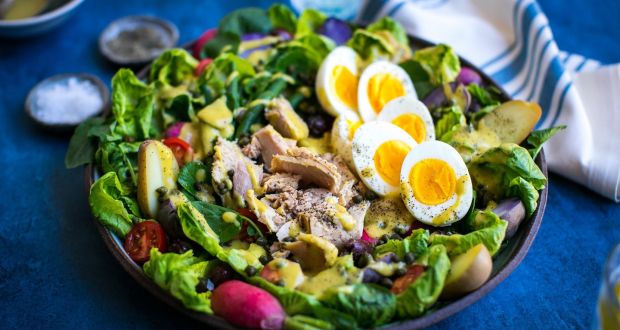
Niçoise tuna with tender boiled eggs

Sport and fitness were not high on my agenda when I was growing up. I was famous in my school for scoring the only own-goal in the school’s sporting history. I knew, as I sat in the school bus on the way home, filled with shame, that sport would not be my forte.
Thankfully, my interest in food kept me occupied during my formative years, but now that I am slightly older and working in a job that requires plenty of eating, finding an activity that keeps me active and I actually enjoy has been important.
Recently, when I moved to Los Angeles, with a lack of cliffs and green landscapes to hike with the dog, I was all set to finally find an activity I could call my own. A crossfit gym in the neighbourhood was offering free trial classes, so I signed up. A week of not being able to walk after dropping a kettle bell on my foot, combined with muscles that were in protest after what they had been subjected to, meant that crossfit was certainly not for me.
After a couple more false starts, with a soul cycle class – pedalling to music while going nowhere fast on a stationary bike – that nearly caused me to collapse, and a cardio barre class that had me exercising with a ballet bar, I stumbled across hot yoga. 
I had been to regular yoga classes before and had fallen in and out of them over the years, but this time I became completely obsessed. I go almost every day. For the first time, I’m excited about exercise, and with all this extra energy being expended, having a balanced diet has never been more important to me.
The recipes this week are aimed at more-balanced eating. Fresh vegetables, good grains and protein are all high on the menu.
A niçoise salad with the spoils of summer, a spiced fish dish full of vibrant colour and flavours and – for those looking for a sweet treat minus the processed sugar – mango, chia seed and yoghurt ice pops to keep you cool.
This is my kind of balanced eating: a feast of flavour filled with ingredients that are good for you.

NIÇOISE TUNA WITH TENDER BOILED EGGS

A niçoise salad might feel somewhat passé, but it’s time for a comeback. This is instant summer food: fresh summer vegetables arranged on a platter with the best-quality tuna – or fish of your choice – pepped up with salty capers, olives and peppery French mustard dressing. Add or subtract ingredients as you wish: this is an ideal salad for interpretation.
Serves 4
200g small, waxy purple and red potatoes
3 large free-range eggs
250g green beans, topped and tailed
2 baby gem lettuce heads, washed and leaves separated
A good handful of watercress, washed
300g of line-caught tuna in olive oil
200g olives, pitted
8 radishes, halved
100g cherry tomatoes, halved
3tbs capers
For the French mustard dressing:
3tbs extra virgin olive oil

Continue Reading >> Source: https://www.irishtimes.com/life-and-style/food-and-drink/healthy-food-is-boring-these-recipes-will-change-your-mind-1.3145707

Who's stopping you: Finally, healthy eating trend catches up

Little to nothing in Obamacare or the Republican replacement effort gets at the issue of reducing health care costs by stopping its true cause, the substantial increase in chronic disease. Type 2 diabetes has grown from 2.2 million to 29 million in America since 1974 when I started to practice.

Hip and knee replacements largely for arthritis from 64,000 to over 1 million; dementia costs from under $10 billion in 1974 to $216 billion in direct federal costs in 2014. You get the picture. Chronic disease is increasing seven-fold faster than our population.

Our genes haven’t changed. Our habits and culture have. We need a World War II effort to save America. Everyone knew in WWII all had to pitch in to survive. That is how serious the influx of chronic disease is. And like in WWII, we think a culture change and a new set of rules promoted by the government are needed.

In 2005, when I arrived in Cleveland and looked at the data, it was obvious that we needed to offer healthier food to America. Without it, America’s medical costs would increase and put the country in jeopardy. It became obvious to me that we needed mass produced food that was healthy.

So I went to the head of one of the three biggest food processors in America and suggested America needed his company to start making food that loves your body as their mainstream foods. These food processors and this one in particular stock the shelves of the biggest grocery stores and provide the ready to use foods for fast and quick serve establishments and restaurants. His response: “Mike, I can’t do it, it’s just a fad. America doesn’t want healthy options. I have to provide what America wants.”

I pleaded and showed him the data. It was obvious by 2005 that America’s weight was going up more than 1 pound per year per person and health going down, enough to bankrupt the country from the cost of care for diabetes, cancer, heart disease, dementia, arthritis and kidney disease that obesity promotes. We were living through the delayed costs from tobacco and despite big tobacco’s best promotional efforts, tobacco-use rates were clearly on the way down from 45 percent of the population in about 1960 to under 25 percent in 2005, and still declining. It is now at about 15 percent.

But if the food choice change took the more than 50 years now required to change tobacco use, our country would be bankrupt. I wondered if we could legislate that healthy food had to be available. And research looking at the safety and effectiveness of government food regulations has shown that responsible rules and regulations can pay off big dividends, not only when it comes to saving lives and preventing the suffering of millions of you, but also by saving big bucks and making our health care system run more smoothly and efficiently.

Let’s start with a look at how food policies could and do affect those suffering from heart disease. In a recent study from the University of Liverpool School of Public Health, researchers estimated that in the United States a 10-percent tax on sugar-sweetened beverages could prevent 31,000 deaths from cardiovascular disease every year. But there’s no reason to stop with policies that impact sugary drinks.

A 30-percent fruit and vegetable subsidy targeting only food stamp recipients was estimated to avert 35,100 cardiovascular deaths and erase economic disparities in health outcomes; a mass media campaign to change dietary habits might avert 25,800 cardiovascular deaths. Instituting all the above could change the health of the nation and the wealth of the country. Plus, the scheduled 2018 ban on trans fats that clog arteries, boost inflammation and promote heart disease could immediately produce more than $60 billion in annual health care savings.

Every three years, I’ve gone back to the CEO of that food company and asked him to “go healthy.”

In the meantime, his sales have only grown. His answers always have been the same: “Mike it’s just a fad. America doesn’t want healthy options.”

But when I visited this year, I saw many healthy foods in the test kitchen, and beginning to roll off the production line. I asked him what was up. His response: “Mike, we’re going with it. Healthy food is now a trend. America wants it.”

Source: http://www.clevelandjewishnews.com/features/health/finally-healthy-eating-trend-catches-up/article_1b17dcd6-67e2-11e7-941d-afea31373ba5.html

Who's stopping you: What's In Your Mac And Cheese Besides Macaroni And Cheese

Mmmm, some macaroni and lots of cheese...and phthalates? (Photo: Shutterstock)

Oh, mac and cheese, what's happened to you? You were the most comfortable of comfort foods. So reliable. So innocent. So simple with not too many ingredients. Just macaroni and cheese...and phthalates.

What the phthalates?! I did not order that with my mac and cheese.

It turns out that mac and cheese, in the words of Britney Spears, is "not that innocent." Based on some testing done by the Coalition for Safer Food Processing and Packaging, if you are eating the cheese powder for macaroni and cheese, you may be eating phthalates. They bought 30 cheese product items from retail stores in the United States, including 10 different varieties of macaroni and cheese with dry cheese powder, five different types of sliced processed cheeses, and 15 varieties of natural cheese such as hard, shredded, string and cottage. They then shipped this whole cheese-heavy shopping haul in its original packaging to VITO (the Flemish Institute for Technological Research), an independent laboratory in Belgium. Rather than simply eat the cheese, VITO tested all of these products and found significant levels of phthalates in all but one of the products. Oh, cheese. What's even more distressing was that the average level of phthalates in macaroni and cheese powder (940 parts per billion measured in the fat and 106 parts per billion calculated in the product) was about twice the levels in processed cheese and four times the levels in natural cheese. Cheese Louise. Is this a lot? That depends on how many boxes of macaroni and cheese you eat per sitting and over time and what other exposures you may have to phthalates.


What exactly are phthalates besides a word that is difficult to pronounce without spitting? They're a group of chemicals that help soften plastics...and they're all around us. The Food and Drug Administration (FDA) website lists many household products that use phthalates such "toys, vinyl flooring and wall covering, detergents, lubricating oils, food packaging, pharmaceuticals, blood bags and tubing, and personal care products, such as nail polish, hair sprays, aftershave lotions, soaps, shampoos, perfumes and other fragrance preparation." The most commonly found phthalate in the VITO testing was DEHP, otherwise known as Di(2-ethylhexyl) phthalate, followed by DEP (Diethyl phthalate), BBP (Benzyl butyl phthalate), and DINP (Diisononyl phthalate). Try saying that five times quickly instead of "she sells seashells by the seashore."

Stephen Colbert enjoys some macaroni and cheese at a taping of 'The Late Show with Stephen Colbert" Photo Credit: Rainmaker Photo/MediaPunch/IPX

What's the harm in eating phthalates (i.e., something in your kitchen floor)? Take a look at the July 2014 report to the U.S. Consumer Product Safety Commission from the Chronic Hazard Advisory Panel on Phthalates and Phthalate Alternatives. A major concern is that phthalates may interfere with the production of testosterone. Decreasing testosterone doesn't just inhibit chest bumping. Studies have shown that phthalates may substantially affect the reproductive tracts of male rats, such as causing malformations and infertility. Scientific evidence suggests that similar problems may occur in male humans, such as poor semen quality, testicular cancer, penis malformations, testicular abnormalities and reduced fertility. Thus, exposing pregnant women and male children to phthalates may be particularly risky.

Scientific studies have also suggested links between phthalate exposure and other health problems. For example, a systematic review published in Environmental Pollution found associations between phthalate exposure and the development of childhood asthma. A study in Pediatric Research showed an association between exposure to certain phthalates while in the womb and subsequent higher body mass index (BMI) and development of obesity. And for those of you still blaming vaccines for autism, this review article in Environmental Research covers various studies that have suggested a connection between phthalate exposure and autism. More scientific studies are necessary to determine what exposure levels may be unsafe, and such thresholds may vary from person to person...but even small exposures can add up over time, so perhaps you want to eliminate sources of unnecessary exposure.

Concerns about health risks have led to varying degrees of phthalate bans throughout the world. A PBS article from 2008 indicated that the European Union, Japan, Mexico, Argentina and other countries have banned phthalates. The article continued to say that as a result, "China, which makes 85% of the world's toys, has developed two manufacturing lines, one for the European market and the other like-minded nations that ban phthalates, and another one for the United States and dozens of mostly developing and third-world countries that don't restrict them." Since then the U.S. has separated itself from "developing and third-world countries" a bit by putting some more restrictions on phthalates, but still not to the degree of the European Union, Japan and other countries.


Source: https://www.forbes.com/sites/brucelee/2017/07/14/whats-in-your-mac-and-cheese-besides-macaroni-and-cheese/#7059aada4caf

7/11/17

Who's stopping you: 6 Food Shopping Mistakes A Nutritionist Wishes Healthy People Would Stop Making


6 food shopping mistakes a nutritionist wishes healthy people would stop making
Photo: Stocksy/Lumina

Savvy grocery shoppers have a few rules they live by: Buy what’s in season, avoid unpronounceable 12-letter ingredients, and beware of too much sugar. But even health-focused supermarket ninjas can get stumped by the more nuanced dilemmas that pop up while you shop: Does egg color really matter? Is loose-leaf lettuce cleaner than the bagged, pre-washed kind? And is skim milk better for you than whole?

These questions are no-brainers for integrative nutritionist Maria Marlowe, CHC. She recently wrote the book on smart shopping—seriously. In The Real Food Grocery Guide, Marlowe answers your pressing questions about how to buy food that’s truly best for your body, from what sneaky ingredients have GMOs to how to choose the most nutrient-dense produce possible.
Here, she uses her insider knowledge to reveal what she wishes more people knew about navigating the grocery store.

Photo: Fair Winds Press

Scroll down for six food shopping mistakes a nutritionist wishes healthy people would stop making.


  1. Buying imported foodHealthy foodies talk a lot about buying local, and many restaurants even tout their regional sourcing on their menus. But what if you live in a city and the closest thing to a farm you have within 50 miles is a community garden? Wouldn’t foods imported from a better environment be better quality?

    Regardless of where you live, Marlowe is still Team Local. “Food in the grocery store is shipped in from all across the country—and world—so it’s picked weeks in advance when it’s still underripe,” she says. “By the time it gets to us, it’s days or weeks old.” During this lag time, nutrients start to degrade. “Getting something from the local farmers’ market that was either picked last night or that morning at its peak ripeness will definitely be more nutritious,” Marlowe says. So prep your shopping list, pack your tote, and set your alarm for a morning trip to the greenmarket.

     The one exception: If your local produce isn’t organic (especially if it’s something on the Dirty Dozen list), Marlowe says the imported option is the better choice.
  2. Choosing pre-washed lettuce

    Whatever your go-to greens may be, bagged salad just seems, well, cleaner than the loose kind. But Marlowe promises it isn’t.

    “The less hands on your greens, the better,” Marlowe says. “With loose salad, you’re the only one washing it and not relying on someone else to do it.” Considering the number of listeria outbreaks linked to pre-washed greens, she seems to be on to something. (She’s not alone—it’s also the one thing a food poisoning expert says he won’t eat.)
  3. Buying farmed fish instead of wild
    When considering your options in the meat aisle, differentiating between pasture-raised, grass-fed, cage-free, free-range, and wild options can get pretty complicated. Just like with your veggies, Marlowe recommends you seek out organic meat, which means that in addition to living hormone- and antibiotic-free lives, even the animals’ feed is GMO-free. She also says you should go for pasture-raised when you can, which means that the animals spent the bulk of their lives outdoors and grazing. If that’s not available, the second-best option is grass-fed, meaning the animals ate grass instead of grains, which is healthier (unfortunately, quinoa bowls aren’t what you’d call cow-friendly).

    For chicken, free-range, free-roaming is the best option, Marlowe says, because it tells you the animals had some element of freedom. But if that’s not available, go for cage-free (although this delineation is more important when buying eggs than poultry).

     As for fish, Marlowe’s advice is to go for ones labeled “wild.” “This [label] means the fish were still raised in an enclosed environment, but they weren’t given any antibiotics or hormones and had more of a freer life than farmed fish.” She also says wild fish tend to have lower mercury levels than their farmed counterparts.
  4. Buying eggs based on shell color

    Speaking of eggs, it’s time to settle this once and for all: Does shell color really matter? “I get asked this a lot,” Marlowe says. “It doesn’t. It just varies because of hen breed.” So no, brown eggs are not healthier than white eggs.

    But what does matter is the color of the yolk. “If you go to the farmers’ market and buy your eggs, usually the yolk is so much more pigmented and bright than when you buy eggs from the grocery store,” she says. It’s almost an orange-yellow color. “When animals are raised more in their natural environment, they tend to be a little more nutritious and taste better.” Case closed.
  5. Choosing skim milk over whole

    People have strong feelings about what fat percentage of milk is best, with many well-meaning healthy eaters opting for a skinny vanilla latte (sugar-free, of course) over the full-fat alternative. But are they right to think it’s better to buy lower fat percentages? In a word: no. Marlowe recommends buying organic milk (for similar reasons as choosing organic meat) and going with the full-fat option. “It’s actually better for you because it’s more filling than the lower-fat versions, so you’ll be satisfied with less,” she says.

    This buying tip extends to yogurt, too. “The fat is what tastes good, so when brands take it out, they have to add something else in—which more often than not is sugar,” Marlowe says. “So while it may be lower in fat, it will be higher in sugar.”

     And, by the way, fat is not a bad thing. “One study also showed that people who drank whole milk were less likely to have acne than those who drank low-fat milk,” Marlowe says. “Also, it seems counterintuitive, but lower-fat milk is associated more with weight gain than full-fat milk.”

     All that being said, Marlowe stresses that a healthy diet does not need to include dairy (which has been linked to inflammation).

    6. Assuming dairy- and gluten-free options are always better

    Prefer nut milk to dairy? Marlowe says the most important trait to keep in mind when deciding between nut milks is a clean ingredients list—and that goes for anything dairy-free. “If you look at some of the alt-milks or [nut cheeses], they have a whole long list of strange additives,” she says. “The key is to find brands that keep it simple—and the good news is that more of them are popping up all the time.” After that, choose whichever you think tastes best.

     Similarly, you’d be wrong to assume that all gluten-free options are healthier than their gluten-filled counterparts. Too many additives and fillers can bring down the health value, so opt for naturally gluten-free grains (like amaranth, quinoa, and oats) when you can.

     Marlowe has one last tip that applies to everything on your shopping list: Pay attention to how what you eat makes you feel. “Your body will talk to you—and if something isn’t good for it, you’ll know.”

     Something new and buzzy to add to your shopping list: Trader Joe’s avocado yogurt. And while you’ve got ingredients lists on the mind, here’s what the term “natural flavors” really means.


Source: https://www.wellandgood.com/good-food/healthy-food-shopping-tips-from-a-nutritionist/